
Originally Published as: Built to Withstand the Worst: Corrosion-Resistant Materials for Animal Confinement Buildings
Is there a product that you swear by? Share with Frame Building News readers by emailing details [email protected].
Animal waste is one of the most corrosive forces a post-frame building can face. From foundation posts to roofing fasteners, no component is immune. Here’s what industry experience and the companies serving agricultural builders tell us about selecting materials that hold up over time.
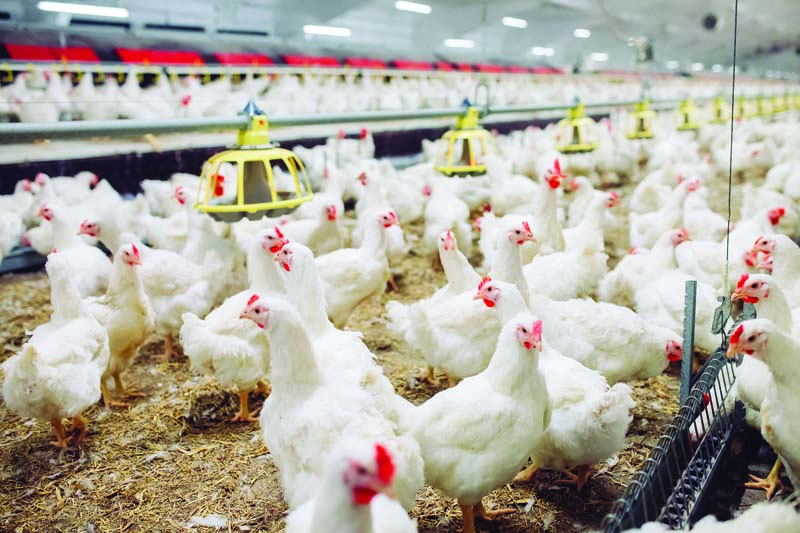
Walk into a working hog confinement barn, a dairy facility, or a cattle feeding operation, and you’ll understand immediately why builders who specialize in agricultural post-frame construction consider corrosion resistance one of their most critical design criteria. The combination of animal waste, decomposing organic matter, biogases, ammonia, high humidity, and the wash-water used to clean these environments creates one of the harshest conditions any building material will ever face.
According to U.S. Steel research cited widely in the post-frame industry, animal waste produces sulfites, ureas, amines, and other corrosive agents. Bacteria in the waste oxidize organic material into organic acids that readily attack aluminum, iron, and zinc. Add in the near-constant high humidity from animal respiration and cleaning cycles, and you have an environment that will accelerate the degradation of unprotected steel, wood, and concrete alike.
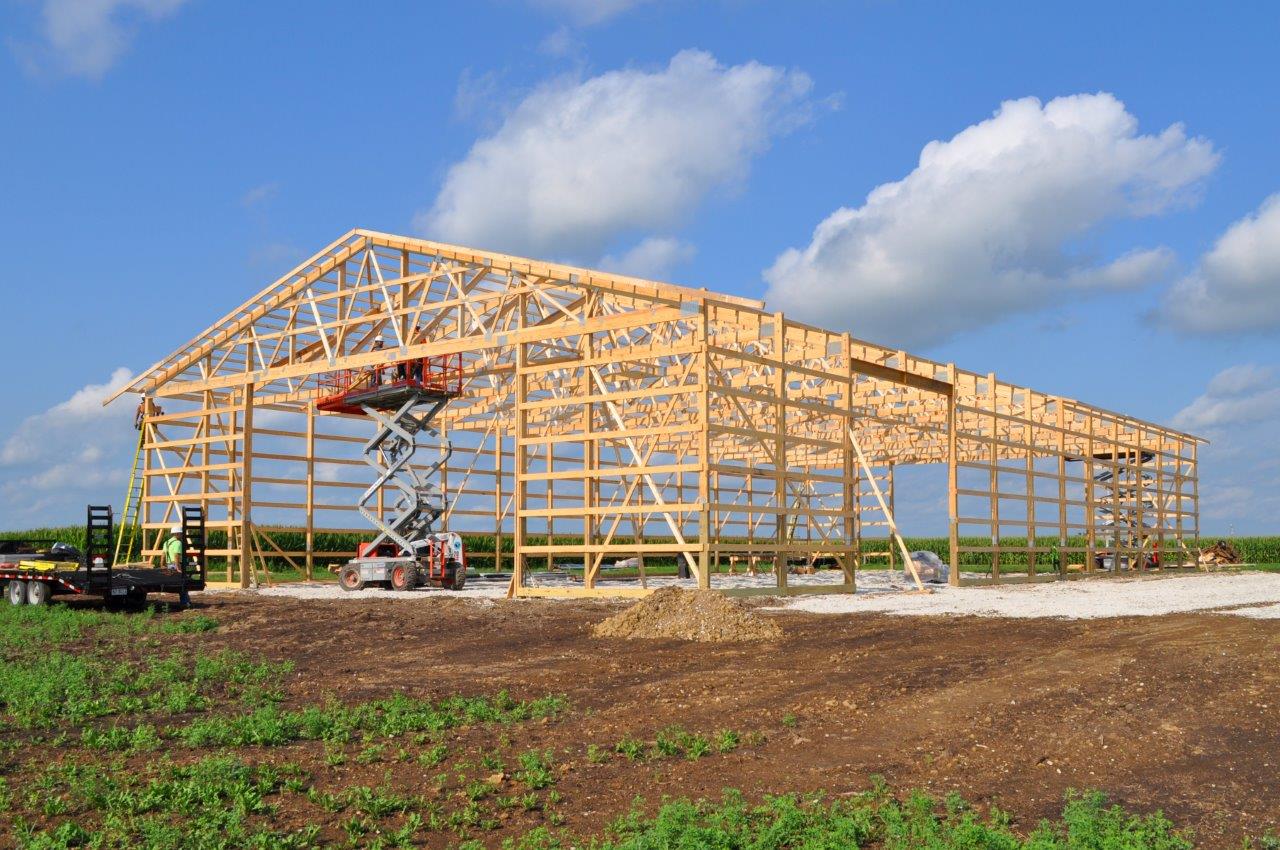
Material science in the post-frame sector has advanced considerably, and the products available to agricultural builders today reflect a much deeper understanding of what it takes to survive a confinement environment. This article examines the major material categories — from posts and foundations to panels, fasteners, and liners — and draws on input from suppliers with significant experience in agricultural projects.
The Foundation Challenge: Keeping Wood Out of Harm’s Way
In any post-frame building, the most vulnerable point is where the structure meets the ground — and in an animal confinement facility, that vulnerability is magnified dramatically. Manure and liquid waste migrate toward the base of walls and columns, creating a persistent chemical attack that, over time, can compromise even pressure-treated lumber.
“If there is animal waste around that post, it’s going to be compromised. Post Protector is simply a physical barrier so that there isn’t direct contact.”
— Post Protector

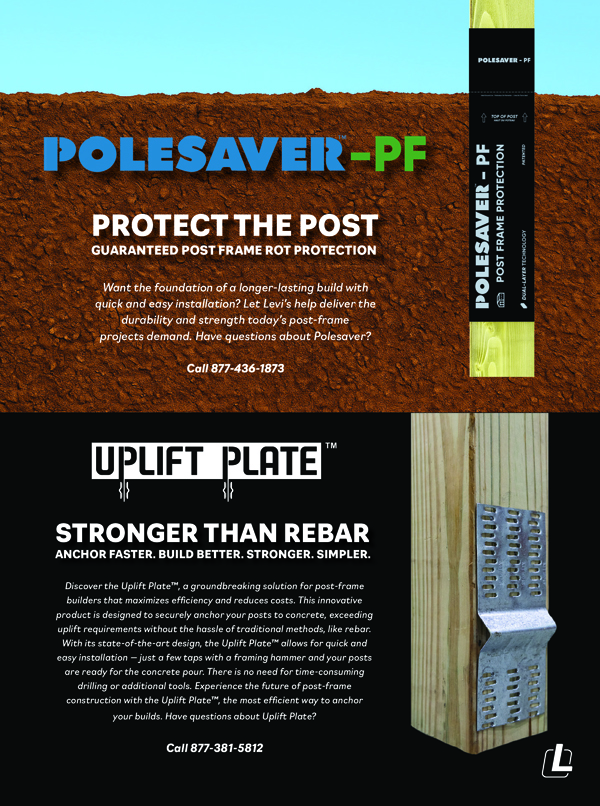
One approach addresses the problem through physical isolation: an HDPE sleeve — fabricated from the same high-density polyethylene used in landfill liners — wraps the embedded portion of the column and prevents direct contact between the wood and surrounding soil, concrete, or waste. The material resists animal waste, manure liquids, and the acidic compounds produced during fermentation.
The sleeve protects against post decay from moisture, insect infestation, animal waste, concrete encasement, and varied soil conditions. Because it fits over the post before installation, the system requires no changes to standard “post-in-ground” construction methods.
Precast concrete columns take a different approach to the same problem: eliminating all wood-to-ground contact. These columns are cast at 10,000 PSI — roughly three times the strength of standard concrete — and reinforced with high-strength rebar. A powder-coated steel U-bracket tops the column and connects it to the wood post above ground, keeping the wood out of the corrosive zone. Additionally, the wood column connected to the column can easily be replaced when damaged by the animals through force like kicking, or animal waste.
Anchor bracket systems extend this same philosophy to slab-on-grade applications, connecting posts to a concrete foundation rather than embedding them in soil. According to a National Frame Building Association survey, builders’ use of wood in the ground was projected to fall 31% over a five-year period, while use of precast concrete columns was expected to grow 43%.
Molded HDPE post covers offer another barrier option. A one-piece cover with an enclosed bottom prevents soil contact while allowing ventilation, and is available in sizes to fit standard post dimensions. Because the wood never contacts the ground, performance is independent of changes in preservative treatment chemistry over time.
Steel Panels: The Zinc and Paint Equation
The steel panels that clad post-frame agricultural buildings have improved dramatically over the past two decades, but animal confinement remains a uniquely demanding environment. Biogases concentrate on interior surfaces. Ammonia from urine attacks zinc coatings. Dust carries corrosive bacteria to every corner of the building. Direct contact with liquid waste will rapidly perforate unprotected steel.
Some post-frame building manufacturers with significant agricultural project histories specify G-90 galvanized steel for all exterior surfaces — providing 50% more zinc coating than G-60 steel. At that specification level, a high-performance paint system such as AkzoNobel Ceram-a-Star 1050 can carry a 40-year warranty against chipping and cracking.
“The combination of high-quality paint systems and protective substrate coatings allows panel manufacturers to offer 40-year warranties against red rust corrosion — especially important where agricultural building environments like animal confinement present challenges to those coatings and paint systems.”
— David Quehl, Director of Sales & Marketing, Direct Metals Inc.
The same paint platform appears across multiple post-frame building lines serving the agricultural market. The consistent specification reflects an industry-wide recognition that long-term field performance in corrosive environments depends on coating quality, not just substrate grade.
For the most extreme interior environments, some builders are turning away from painted steel entirely on interior surfaces. The question of which base material — galvanized, Galvalume, or aluminum — performs best in a given confinement application deserves careful thought. Galvalume (a continuous hot-dip aluminum-zinc alloy coating, typically 55% aluminum and 45% zinc) provides strong overall corrosion resistance, but standard galvanized G-90 or higher is generally preferred on interior walls of livestock buildings because the zinc layer sacrifices itself to protect the steel substrate at cut edges and scratches. Aluminum panels can offer excellent corrosion resistance but require special consideration when selecting fasteners, as discussed below.
Fasteners: The Small Component That Causes Big Problems
Fasteners are the most underappreciated component in an agricultural building — right up until they fail. In a corrosive animal confinement environment, an undersized zinc coating on a screw or nail can corrode completely before the panel it holds has shown any sign of wear. That failure doesn’t just mean a loose panel; it can mean water infiltration, structural compromise, and costly call-backs.
Stainless steel fastener manufacturers have documented why their products outperform standard zinc-plated alternatives in livestock environments.
“Since animal sweat and waste can be particularly corrosive, hog confinement buildings and other livestock areas are ideal projects for using this rugged material. The alloy itself ‘work-hardens’ during the nail making process — so these fasteners tend to be very durable and bend-resistant during pounding.”
— Roelif Loveland, President, Maze Nails
Stainless steel’s corrosion resistance comes from a passive chromium oxide layer that reforms even after scratching. Type 304 stainless steel (a chromium-nickel alloy) handles most agricultural environments; Type 316 (which adds molybdenum) is the appropriate choice for the most severe or marine-adjacent conditions. Both types are available in plain-shank and ring-shank configurations for hand-driven and pneumatic tools.
The International Residential Code (Section R317.3.1) and the 2018 International Building Code (Section 2304.10.5.1) both specify that fasteners in contact with preservative-treated wood must be hot-dipped zinc-coated galvanized steel, stainless steel, silicon bronze, or copper. Commercial-grade zinc plating — as little as 4 microns — is explicitly insufficient for extreme environments. The installation process itself is part of the problem: the stress from an impact driver on fastener threads can compromise thin coatings at the moment of application.
For builders using aluminum panels on interior surfaces, an important note: the default choice of 304 stainless steel fasteners can cause galvanic corrosion, depending on the specific aluminum alloy. Dissimilar metal contact causes the aluminum to sacrifice itself to protect the fastener — the opposite of the intended outcome. Consulting with the panel supplier before specifying fasteners is essential.
PVC Liner Panels: Chemical Resistance for Interior Surfaces
For the interior walls and ceilings of animal confinement buildings, PVC liner panels are widely used due to their resistance to chemical environments. Unlike steel or wood, PVC does not rust, rot, chip, or peel, and it is chemically resistant to the ammonia and organic acids produced by the decomposition of animal waste.
PVC liner panel systems are available through post-frame building suppliers and are suited to animal confinement buildings, car washes, and food processing facilities — environments where moisture, chemicals, and abrasion are ongoing concerns. Impact-resistant formulations are common, and manufacturer warranties typically range from 5 to 10 years, depending on UV exposure requirements.
Condensation barriers applied to the underside of metal roof panels take a different approach to protecting interior steel. If your condensation barrier uses a rubber-based adhesive, this adds an additional layer of protection from all of the corrosive elements mentioned above. Additionally, the fleece-like material prevents moisture — and theThe fleece-like material prevents moisture — and the corrosive gases dissolved in that moisture — from contacting the steel substrate. Laboratory testing using microscopic cross-section analysis has confirmed that a well-adhered condensation barrier layer creates a chemical barrier from the acidic environment, prolonging the service life of the steel.
“PVC will not rust or corrode from ammonia and other harmful compounds commonly found in animal waste and its off-gassing, and offers some noise-dampening qualities, keeping livestock calmer.”
— Referenced in Frame Building News, “Post-Frame Ag Buildings – Built to Last.”
Rigid corrugated PVC panels are another option suited to ceiling applications in agricultural buildings. They withstand high-pressure water cleaning, are non-flammable, and are rated for use in fertilizer and salt storage buildings as well as livestock facilities. Builders should note that PVC panels require pre-drilling to allow for expansion and contraction, and that ceiling applications have a maximum recommended span of 24 inches.
Concrete Floors: Getting the Mix Right
Concrete floors in livestock buildings are exposed to continuous chemical attack from urine, manure, and organic acids. When the concrete mix isn’t right, or the rebar is too close to the surface, the results can include accelerated corrosion of the reinforcement and slab spalling.
Agricultural engineers working in livestock facility design consistently emphasize two points: adequate concrete cover over the rebar, and a concrete mix with sufficient density to resist acid penetration. Precast concrete column products address this by incorporating microsilica, which enhances compressive strength and erosion resistance, and corrosion inhibitors that protect embedded rebar and steel brackets from chemical attack. The same principles apply to poured concrete foundations and slabs in confinement facilities.
Floor type selection also has long-term implications for how waste is managed — and therefore how aggressively the building is attacked. Solid concrete floors (grooved or roughened for traction) are warmer in cold months and easier to manage for composted pack bedding systems, but they hold manure for extended periods. Slatted floors over pits allow waste to drop away from animals and from the building’s interior surfaces, but require a minimum of six months of below-floor manure storage and demand careful attention to the corrosion resistance of the concrete and any embedded metal components in the pit area.
Ventilation: The First Line of Defense
No discussion of corrosion resistance in animal confinement buildings is complete without addressing ventilation. The biogases generated in a livestock facility — hydrogen sulfide, ammonia, carbon dioxide, and methane, chief among them — are not only hazardous to animal and human health but are directly corrosive to the building’s structural and surface materials.
Agricultural engineers have long noted that ventilation effectiveness can be estimated simply by smell: a well-ventilated building smells better because the corrosive gases are being continuously diluted and expelled. Any reduction in the concentration of those gases reduces their corrosive impact on metal surfaces, coatings, and concrete.
Post-frame agricultural building systems designed for confinement operations incorporate ventilation as a core element, offering options ranging from natural ventilation with ridge vents and sidewall openings to mechanically assisted tunnel ventilation for high-density operations. Ventilation choices directly affect both animal health and building longevity.
Building orientation and roofline design also play a role. A monoslope barn, open on one side, naturally disperses corrosive fumes away from the structure more effectively than a fully enclosed building. For enclosed designs, discharge tube stacks that vent exhaust gases above and away from the roof surface significantly reduce exterior panel corrosion.
Putting It All Together: A Systems Approach
The most important takeaway for post-frame builders working in agricultural markets is that corrosion resistance is a system, not a product. A G-90 galvanized panel is undermined by a commercial-grade fastener. A premium stainless-steel fastener is wasted if the post it secures is rotting underground. Perma-Column® piers protect the foundation, but only if the concrete floor above them is properly designed. PVC liner panels protect the wall framing, but only if the ventilation system is removing the corrosive air from the building.
Manufacturers and suppliers with significant agricultural project histories have integrated this systems thinking into their product specifications and planning tools. Working with suppliers who understand the full building environment — not just individual product categories — helps builders avoid specification gaps that can compromise performance across the whole structure.
The same principle holds on the supply side. Post-frame building suppliers with deep agricultural market experience consistently note that material choices made at the specification stage — foundation type, panel grade, fastener alloy, liner material — are the primary determinants of how a building performs a decade or more after construction.
For post-frame builders working in agricultural markets, the practical implication is straightforward: premature failure — whether from post rot, panel perforation, or fastener corrosion — generates call-backs, repair costs, and potential structural liability. Specifying corrosion-resistant materials from the outset is both a technical requirement and a long-term cost consideration.
Corrosion-Resistance Checklist for Agricultural Post-Frame Builds
Foundation: Specify precast concrete piers or a full HDPE barrier sleeve to prevent wood-to-ground or wood-to-waste contact.
Steel panels (exterior): G-90 galvanized minimum; consider G-115 or higher for the most corrosive environments. Verify paint system warranty (minimum 40 years).
Steel panels (interior): Use PVC liner panels instead of steel on interior walls and ceilings in animal confinement spaces.
Condensation barrier: Apply a fleece-backed condensation barrier to interior roof steel surfaces to prevent corrosive condensate from contacting the substrate.
Fasteners: Specify 304 or 316 stainless steel screws and nails for animal confinement applications. Avoid commercial-grade zinc-plated fasteners. Match the fastener warranty to the panel warranty.
Concrete: Ensure adequate rebar cover depth. Specify microsilica-enhanced concrete for pits and slabs in high-waste areas.
Ventilation: Design for continuous airflow to dilute biogases. Specify ridge vents, curtain walls, or tunnel ventilation appropriate to species and stocking density.
Floors: Select floor type (solid vs. slatted) based on waste management plan, and ensure all embedded components meet the corrosion requirements of the environment.
Industry Organizations
• National Frame Building Association (NFBA) — nfba.org — Standards, education, and industry research for post-frame construction
• American Iron and Steel Institute (AISI) — steel.org — Technical standards for steel construction, including corrosion protection
Company Resources
• Wick Buildings — wickbuildings.com — Agricultural building systems, planning guides, animal confinement design
• Post Protector — postprotector.com — HDPE post barrier sleeves for post-frame foundations
• Perma-Column® — permacolumn.com — Precast concrete columns and Sturdi-Wall® anchor brackets
• Graber Post Buildings — graberpost.com — Post-frame building supply, including Ag-Tuf®
PVC liner panels
• Plasti-Sleeve — plastisleeve.com — Molded HDPE plastic sleeves for protection
of Post Frame columns.
• Maze Nails — mazenails.com — Stainless steel and hot-dipped galvanized nails
for agricultural construction
• DR!PSTOP / FILC USA — dripstop.com — Condensation barrier for metal roof panels
in animal confinement