
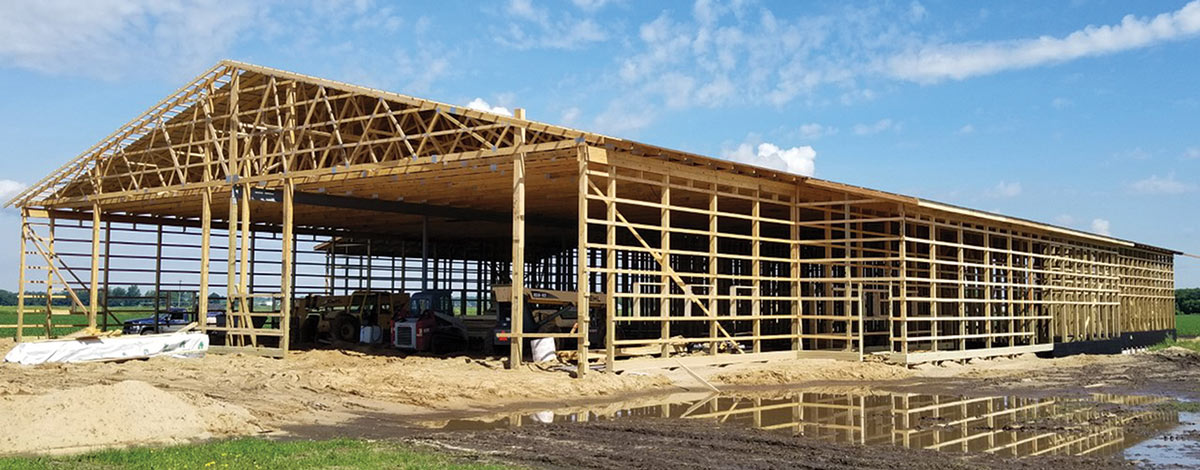
Laminated structural components enhance strength and stability in construction. Commonly used in post-frame building in the forms of glulam or nail-lam columns and trusses, they are important to the structural integrity.
In today’s world of pre-manufactured components, delamination is rare when they are supplied by quality-conscious manufacturers. Their engineers and craftsmen understand laminated components and how they work. It is a good idea for builders to understand how to handle and use them to produce a stronger, more durable building.
Some estimates say that 20 to 30% of post-frame builders make their own nail-lam components, and they need to understand the requirements of creating durable, long-lasting laminates.

When laminates fail through delamination, it means the adhesive bonds are failing in glulam. In nail-lam, it means the layers are loosening. In either case, the laminated component begins to lose efficacy as it fails to act as a single unit.
How Manufacturers Have Worked To Stamp Out Delamination
Engineering Laminated Components
Both glulams and nail-lams produced by conscientious manufacturers are carefully pre-engineered.
National Design Specifications for Wood Construction (NDS) are published by the American Wood Council (AWC) and provide the requirements for glulam columns. For glulam trusses, engineers use ANSI/AITC A190.1, which provides glulam manufacturing standards. ASTM D198 and ASTM D3737 specify testing protocol.
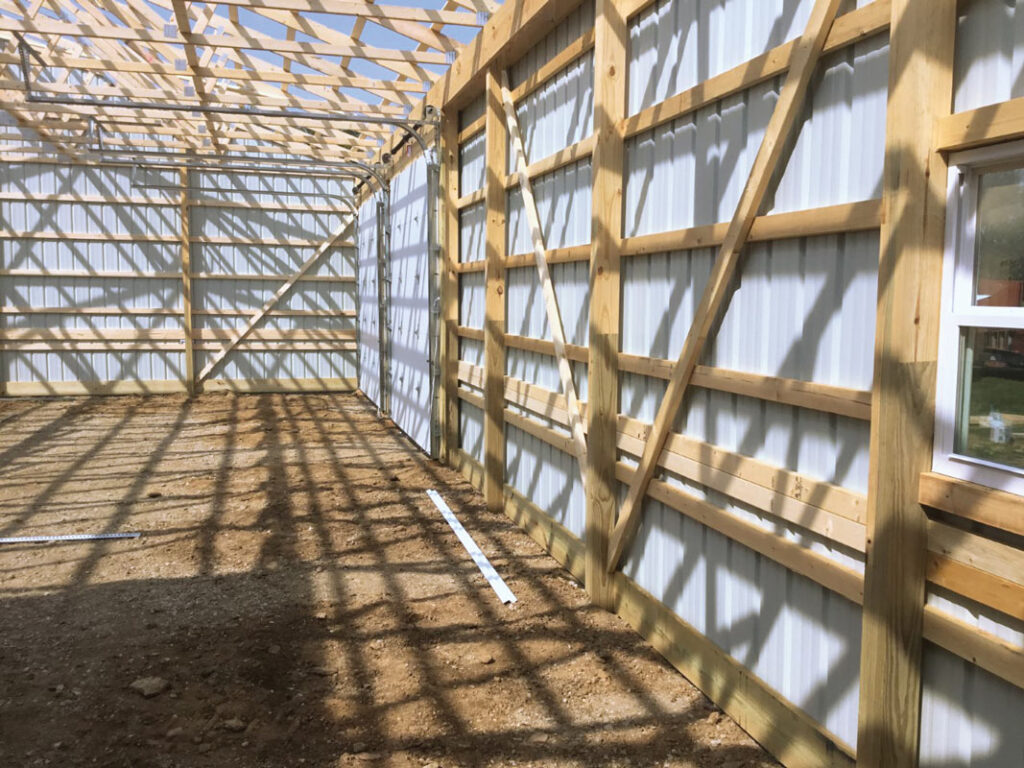
Because nail-lams are often custom-fabricated, there are no standardized design tables to consult, so engineers must calculate for each project using guidelines laid out in the NDS, including load sharing between laminates; fastener capacities, spacing, and depth; bending, shear, and compression properties; stability and lateral support; bending strength and stiffness.

Nail Laminate Procedures
Travis Wilson of Richland Laminated Columns said, “Nail-lams start with wood that is kiln dried at a treatment facility. Then it is sorted for wane, moisture content, warp, and more. If it fails to meet the requirements for any of these qualities, then it is rejected and disposed of because the facility is required to maintain moisture at a certain percentage.” Generally, that percentage is below 19%, but it can be more specific; for indoor and conditioned spaces it can be 12-15%, and for unconditioned, agricultural buildings the acceptable moisture content should be 12-19%.
At all times throughout manufacturing, the laminates are stored in a heated facility so that not only is moisture prevented from entering, but a stable, uniform temperature can prevent laminates from expanding or contracting unevenly, warping, shrinking, and checking, and nails loosening due to movement at the joint.
Nails are applied by a machine with a set nail pattern which has been pre-engineered to create the most durable nail-lams to support the load.
The laminates are then sent to temperature-controlled storage for curing, and they are retained there until they are sent to a jobsite, because once they are at the jobsite, they are often at the mercy of the weather, Wilson said.
According to Wilson, the most important precaution is quality inspection. The components are checked on a daily basis and pulled from inventory if there are any signs of trouble.
Handling Nail Laminates
Laminates should be stored in their packaging, off the ground, and under cover. This helps avoid exposing the carefully created and preserved laminate from absorbing a lot of moisture and, to a certain extent, provides UV protection.
“If you store nail-lams on the jobsite for a week following these precautions, they should be fine,” Wilson said. “However, they shouldn’t be left on-site for six months; this is why we hold them at our facility for a while to help our builders.”
When installing the nail-lam, a builder must ensure they install the component correctly, as per the engineer’s plan. Some manufacturers will stamp the item so it is easy to identify how it should be attached. If it is not clear, the builder should contact the vendor.
Glulam Procedures
Like nail-lam producers, glulam manufacturers choose their wood carefully; it is kiln-dried to approximately 12% plus or minus 3%. In humid regions, the upper range of moisture is good, and in dry, arid regions the lower range is a better match to the air’s moisture content. This wood is sorted to remove pieces that do not meet moisture requirements along with those that are warped or waned.
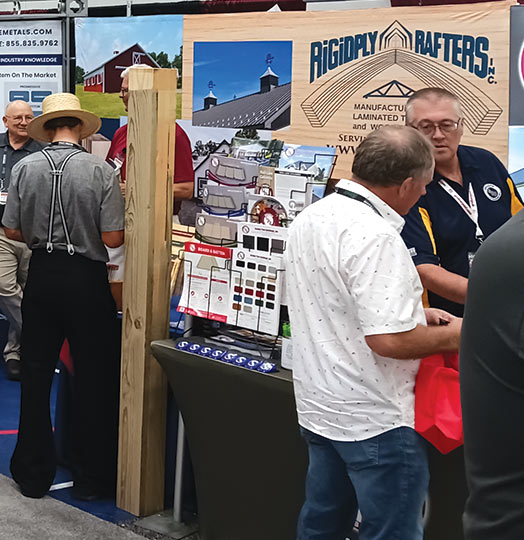
Eric Hershey of Rigidply Rafters said that the face of the wood is planed for uniform lamination thickness and to open the cells so that the glue can penetrate better. The wood must be promptly glued while the cells remain open. The glue is applied in uniform consistency and placed through an automated system, and then the laminate is compressed and left in a temperature-and-moisture-controlled room to cure.
Most importantly, according to Hershey, the Pacific Lumber Inspection Bureau/American Institute of Timber Construction performs quarterly audits. Laminate testing includes breaking the glulam at the face, the finger joint, and soaking the beam then drying it quickly. With each variation, they apply pressure and find out how the laminate responds. This testing is performed on every production line and every wood species running that day; the results are either pass or fail. If it’s a failure, the whole batch is discarded, and the process starts from the beginning.
Handling Glue Laminates
Glulams, as well as all wood and wood products, should be protected from the elements during the building process because it minimizes the opportunity for the wood to warp or check, although glulams tend to check and warp less than other wood products, according to Hershey.
These laminates should remain wrapped, should be kept off the ground, and though covered, they should have the ability to “breathe.” All of these precautions are to limit the moisture they are exposed to.
These precautions are designed to prevent delamination.
Wood Checking in Laminates
Unlike delamination, checking is a natural part of wood drying. It is pretty easy to determine whether the fracture in the wood is delamination or checking. While checking can follow a glue line as delamination would, with checking you will notice the separation of wood fibers rather than a separation of the two pieces of wood.
Lumber quality is not what it used to be even 10 years ago, Wilson said, as smaller species of trees are forced to grow rapidly in order to meet demand. This has made some wood much less dense, which could be responsible for some of the accelerated checking that some people believe they are seeing in wood. Others believe that the claim of more checking is simply the result of the trend in building to expose more structural wood components.
Either way, the consensus seems to be that checking is more a matter of aesthetics than quality or strength. The American Institute of Timber Construction (AITC) has publications that help with evaluating if checking is a problem; in most cases it is not.
Best Practice Summary
Laminates need to be structurally sound and able to withstand the loads the structure will be subjected to. If a builder chooses to make their own laminates, they should follow the guidelines laid out in the NDS, available through the AITC or an engineer. If a builder chooses to purchase their nail-lams or glulams, they should check that the manufacturer is pre-engineering their laminates and doing quality checks on a regular basis. These practices can help ensure strength and quality in some of the most structurally important components of post-frame projects.
Resources
American Institute of Timber Construction (AITC) • https://plib.org/aitc/?ag
American Wood Council • https://awc.org/
Graber Post Buildings • www.graberpost.com
Richland Laminated Columns • www.richlandcolumns.com
Rigidply Rafters • www.rigidply.com
Starwood Rafters • www.starwoodrafters.com
Symun Systems, Inc. • www.symun.com