
Originally Published as: Acoustic Solutions in Post-Frame: How to Build a Quiet Interior
Acoustic performance in a building isn’t the result of a single product choice—it’s the outcome of an entire assembly that is designed, detailed, and installed with acoustics in mind. That’s especially true in post-frame construction, where large open spaces, metal cladding, and long structural spans can create both opportunities and challenges for sound control.
The key for builders is understanding what problem they’re trying to solve. Sound behaves in predictable ways, and once those fundamentals are clear, material and assembly choices become more straightforward.

How Sound Moves Through Buildings
Sound travels in two primary ways: through the air and through the structure. Airborne sound includes voices, music, and traffic noise. Structure-borne sound includes vibration – footsteps, mechanical equipment, or impact noise – that moves through framing members.
These two paths require different strategies. Airborne sound is managed by adding mass and absorption. Structure-borne sound is controlled by interrupting the path which is often referred to as decoupling.
If a wall or ceiling system has a continuous structural connection from one side to the other, most of the sound energy will follow that path. In practical terms, that means even a well-insulated wall can transmit significant noise if the framing directly connects both faces. Builders often assume insulation alone will solve the problem, but insulation primarily absorbs sound within a post-frame cavity; it does not stop vibration from traveling through framing.
Absorption vs. Blocking: Why Both Matter
Absorption and blocking are often discussed interchangeably, but they serve different roles. Insulation materials such as fiberglass and mineral wool absorb sound by leveraging the aerodynamic air within their fiber structure, reducing the energy of airborne sound waves.
Blocking sound, on the other hand, depends on mass. Heavier, denser assemblies—multiple layers, concrete, or masonry are more effective at preventing sound from passing through.

Absorption and mass need to be understood as complementary, not competing strategies. Insulation like stone wool is designed to absorb sound energy within a cavity, while materials like drywall provide the mass needed to block transmission.
In practice, a wall might use insulation to absorb sound within the cavity and layered gypsum board to add mass and limit transmission. Even then, performance depends on the weakest link. Openings, gaps, and rigid connections (as opposed to decoupled components) can undermine otherwise solid assemblies.
The Role of Assemblies, Not Just Products
One of the most common missteps in acoustic design is focusing on individual products rather than complete assemblies. Acoustic ratings such as STC (Sound Transmission Class) are assigned to tested wall, floor, or ceiling systems – not to insulation alone.
For example, a basic 2×4 wall with gypsum board on both sides may achieve an STC in the low 30s. Adding insulation can improve that rating into the upper 30s, but meaningful gains beyond that may require changes to the assembly itself – additional layers or structural separation such as resilient channels.
A useful rule of thumb: an increase of about 10 STC points is perceived as roughly cutting sound transmission in half. That kind of improvement rarely comes from a single upgrade; it comes from combining strategies.
Acoustic performance is always measured at the system level. Ratings like STC are based on full wall or floor assemblies, not individual materials. That’s why looking at tested assemblies is critical when setting expectations.
Insulation Expectations
Insulation is often the first place people look when they want to improve acoustics, but it’s important to understand what role it actually plays. Materials like fiberglass and mineral wool are sound absorbers, not sound blockers. They reduce the energy of sound waves within a cavity, but they do not stop sound from passing through a wall on their own.
Both fiberglass and mineral wool work by trapping air within a dense network of fibers. As sound waves enter the material, they force air molecules to move through that fibrous structure. The friction created in that process converts some of the sound energy into a small amount of heat, reducing the intensity of the sound – particularly in mid- to high-frequency ranges.
Sound absorption happens as air moves through the fiber structure. The denser and thicker the material, the more opportunity there is to dissipate that energy, particularly at mid- to high-frequency ranges.
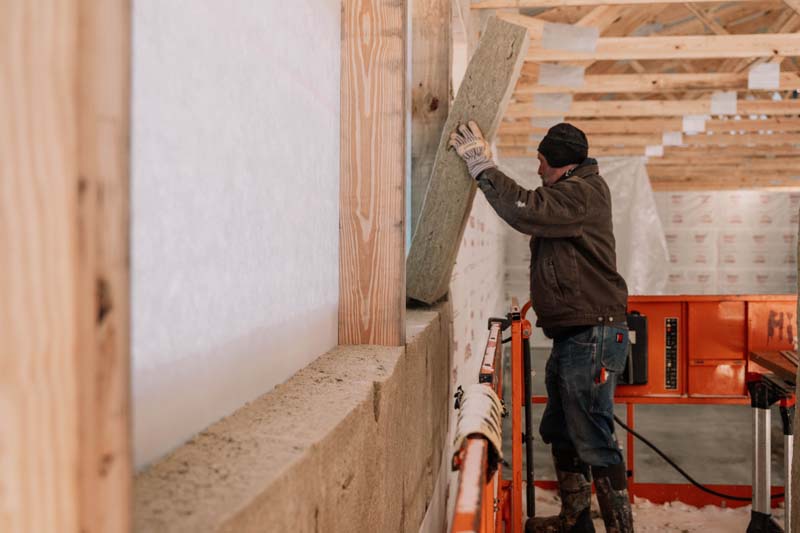
Mineral wool tends to be denser than fiberglass possessing a much higher airflow resistivity which generally allows it to absorb lower frequencies. Fiberglass can still perform effectively in many wall and ceiling applications, especially when installed to fully fill the cavity without gaps or compression. In both cases, consistency of installation matters as much as material choice; voids, misalignment, or compressed batts reduce performance.
What insulation does not do is stop sound transmission by itself. Without mass or isolation, sound can still travel through framing members and finish materials. This is why insulated walls that lack additional acoustic strategies can still allow voices, equipment noise, or impact sounds to pass through.
The takeaway is straightforward: insulation improves acoustic performance inside an assembly, but it is only one part of the system. It works best when paired with mass (such as gypsum board) and, where needed, separation strategies that limit how vibration moves through the structure.
Decoupling: Breaking the Sound Path
Decoupling is one of the most effective—and often misunderstood—tools available to builders. The concept is simple: interrupt the direct path that vibration follows through framing.
Resilient channels are a common approach. These thin metal members are installed between the framing and drywall, allowing the drywall to “float” slightly and reducing vibration transfer. However, their effectiveness depends entirely on insulation. While resilient channels prevent the structural transfer of the acoustic energy, it finds another path by moving into the wall cavity. Without insulation in the cavity the effectiveness of the resilient channel is greatly reduced. If drywall fasteners penetrate through the channel into the framing, their effectiveness is largely lost.
More advanced approaches include staggered stud or double-stud walls, where each side of the wall is structurally independent. Both choices rely on insulation to perform optimally. These assemblies can achieve significantly higher STC ratings, but they require more space and coordination.
For floors and ceilings, similar principles apply. Underlayments, acoustic mats, and isolation clips help reduce impact noise by separating finish surfaces from structural members.
Frequency Matters More Than Most Builders Realize
Not all sound is created equal. High-frequency sounds – like speech – are relatively easy to absorb and control. Low-frequency sounds like bass or mechanical rumble have longer wavelengths and are much harder to stop.
Material choice and thickness play a role here. Lower airflow resistivity materials, which also tend to have lower densities, may perform well in mid- or high-range frequencies, while higher airflow resistivity materials can improve absorption in lower frequencies. But no insulation alone will fully address low-frequency transmission; that typically requires added mass or more advanced assemblies.
This is why a space may feel “quieter” after adding insulation but still transmit certain types of noise. The improvement is real, but frequency-dependent.
Air Sealing: The Overlooked Factor
Small gaps can have an outsized impact on acoustic performance. Sound behaves much like air; it will find the easiest path through an assembly.
A continuous barrier – without breaks, cracks, or penetrations – is essential to maintaining acoustic performance.
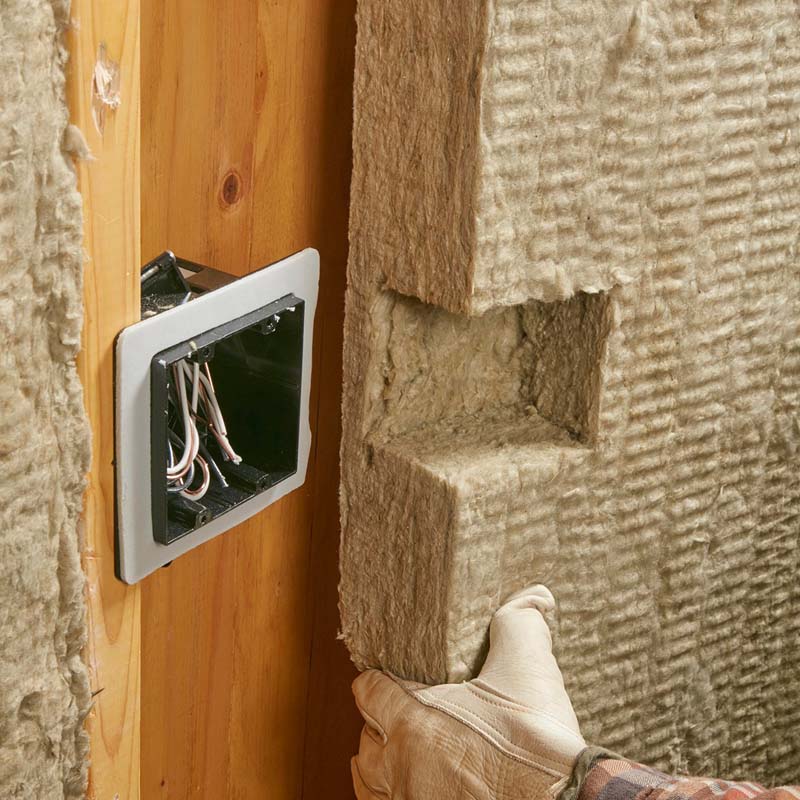
Openings around electrical boxes, plumbing penetrations, ductwork, and even small cracks can allow sound to bypass otherwise well-designed walls. Sealing these pathways with acoustic sealants, gaskets, or putty pads is often one of the most cost-effective improvements a builder can make.
Layout decisions matter as well. Placing electrical boxes back-to-back in the same wall cavity creates a direct path for sound. Offsetting them or using insulated boxes helps maintain separation.
Material Choices in Post-Frame Construction
Post-frame buildings introduce some unique acoustic considerations. Metal cladding, for example, transmits sound more readily than heavier exterior materials like masonry, making it less effective at blocking exterior noise.
That doesn’t mean post-frame buildings can’t perform well acoustically, it just means the wall assembly needs to do more of the work. Continuous insulation, proper sheathing, and layered interior finishes all contribute to overall performance.
Windows and doors are another common weak point. Even high-performing wall systems can be compromised by lightweight doors or poorly sealed window assemblies. Upgrading to solid-core doors and multi-pane glazing can significantly improve results.
Impact Noise vs. Airborne Noise
Airborne sound and impact sound act differently. Airborne noise is addressed through mass and absorption, while impact noise, such as footsteps, is managed by isolating surfaces.
Carpet, acoustic underlayments, and floating floor systems can all reduce impact noise. Adding mass to ceilings below or using isolation clips can further improve performance in multi-level spaces.
Installation Quality Is the Difference Maker
Acoustic performance is highly sensitive to installation quality. Gaps in insulation, poorly sealed penetrations, or incorrectly installed resilient channels can all reduce effectiveness.
In many cases, the difference between a good assembly and a poor one comes down to execution. Insulation that fully fills the cavity, continuous air sealing, and attention to detailing at edges and transitions are all critical.
The same is true for long-term performance. Materials like fiberglass and stone wool are designed to maintain their structure over time, but only if they are properly installed and protected from excessive moisture.
Choosing the Right Approach
If the acoustic goal is reducing sound between rooms, focus on wall assemblies – insulation, added drywall layers, and decoupling where needed. If exterior noise is the concern, prioritize mass, airtightness, and high-performance openings. For impact noise, look to floor and ceiling isolation.
Above all, think in systems. Insulation, drywall, framing, sealants, and layout all work together. While a single product can help, no single product will deliver full acoustic control on its own. However, a well-designed assembly can produce a noticeable and measurable difference in how a space sounds and feels.
Resources
•Owens Corning https://www.owenscorning.com/en-us
•ROCKWOOL https://www.rockwool.com/north-america/