
Originally Published as: Galvanized and Galvalume: What’s the difference, and what makes sense for you?
August 2006 FLASHBACK
Twenty years ago, this article tackled a debate that still exists in the post-frame industry today: galvanized or Galvalume?
For builders, the choice isn’t just about what’s in stock or what’s priced right this week. It’s about long-term performance, warranty exposure, regional corrosion risks, and ultimately, your reputation. The steel panels you use in a roof or wall system will either protect your customer’s investment for decades — or create callbacks that could have been avoided with better information.
Much has changed since this piece first ran. Post-frame buildings are no longer “just farm structures.” But no matter the purpose, owners expect durability and appearance to hold up.
Yet the core questions remain the same: How do galvanized and Galvalume truly compare?
We’re republishing this article because the fundamentals still matter — and informed builders are better builders.
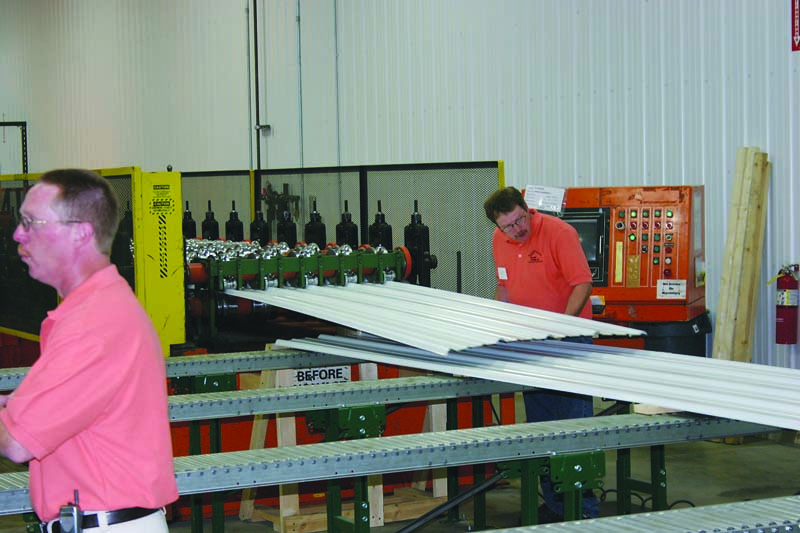
When it comes to the post-frame building market, two steel products dominate: galvanized and Galvalume. Aluminum makes an appearance in certain applications, and alternative materials are often chosen for roofs and walls, but builders turn to the two major types of sheet steel more than any other for post-frame structures.
Which is more popular, and which performs better? As might be expected, it depends on whom you ask, and where you ask it. Most major roll formers carry both products in their line to some extent and find buyers for each.
“Galvalume is the most popular for us, that’s always been the case,” says Ken Gieseke of McElroy Metal, which offers the Max-Rib, its most popular post-frame panel, in both galvanized and Galvalume. “But we sure don’t sit there and badmouth galvanized. There are a lot of people who still think galvanized is better, and we’re not in a position to say they’re wrong.”
Still, in reading promotional materials and technical bulletins, it appears that Galvalume has staked a claim to being the more “premium” product of the two, touting exposure test results and warranties. “The big thing about Galvalume is it will last two or four times longer than galvanized,” says Bill Coleman of American Building Components, which sells primarily Galvalume products. “It has better corrosion resistance, and comes with a substrate warranty.”
Galvanized advocates say the difference in perception comes because zinc people haven’t been loud enough in their touting. One industry veteran believes strong marketing has been the driving force behind Galvalume’s rise to prominence, and that the premium prices being charged for products like Galvalume are not always justified when comparing their performance with galvanized.
Definitions
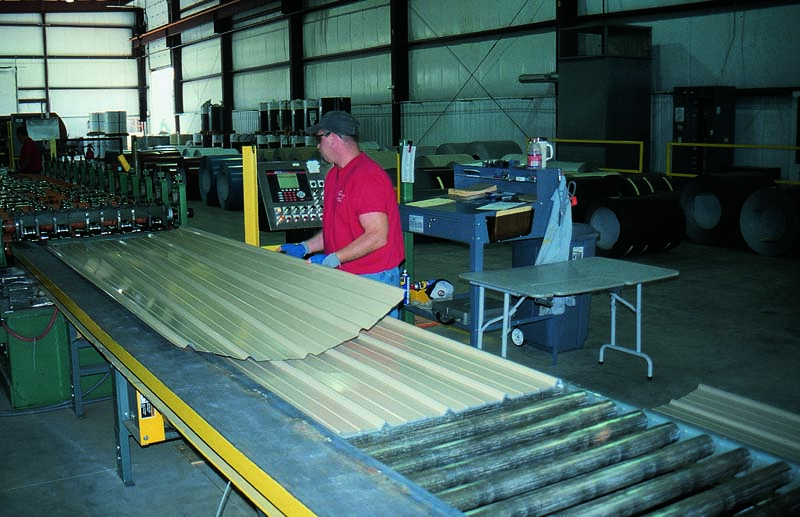
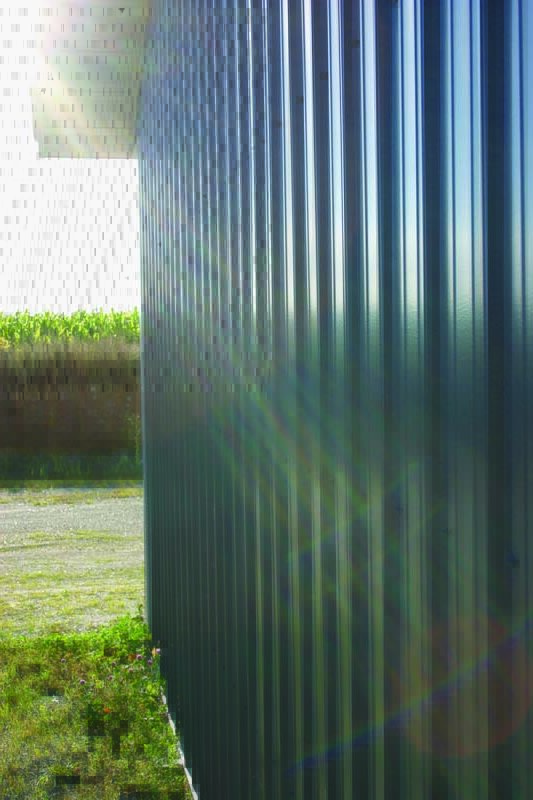
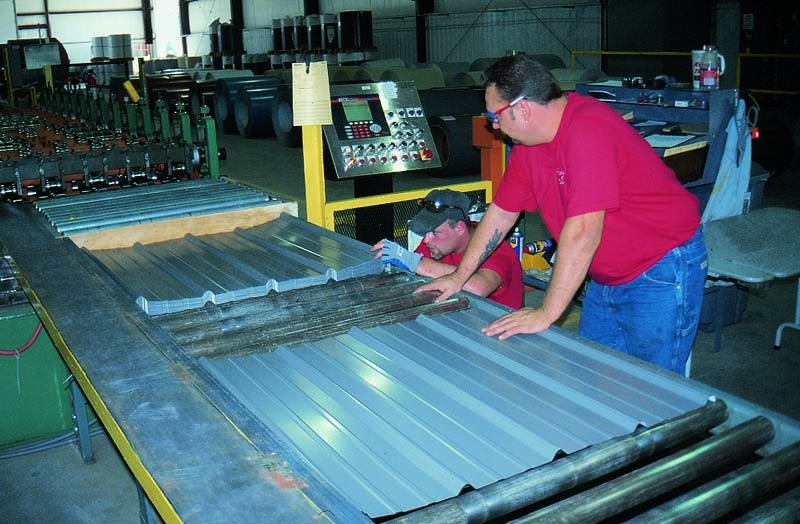
Hot-dip galvanized sheet steel is coated with zinc in a continuous hot-dip coating process, combining the formability and corrosion protection of zinc with the cost effectiveness of steel. From its earliest uses, galvanized metal was usually painted, and was left bare only for non-residential applications or to cut costs. With its distinctive spangle and dark weathered appearance, the strong association of unpainted galvanized with industrial and utility applications has kept it from widespread architectural acceptance.
Galvanized steel used in roofing and siding ranges from G-30 to G-100. The G rating refers to the amount of zinc per square foot; G-90 has an average of 0.90 ounces of zinc total on both sides. Heavier coatings last longer, although heavier layers are more susceptible to cracking during forming.
Galvalume is a surface coating applied to steel coil that contains 55 percent aluminum, about 1.5 percent silicon, and the balance zinc (aluminum levels can vary slightly either way). The coating is applied using a continuous hot-dip coating process and combines the galvanic corrosion protection of zinc with the passivating barrier protection of aluminum.
The material was developed in the 1960s at Bethlehem Steel and was introduced commercially in 1972. It is now produced to strict standards under license throughout the world, and is marketed under a variety of names, primarily Galvalume and Zincalume in North America.
Galvalume combines the anodic sacrificial protection offered by zinc with the barrier protection of aluminum. The result is more than the sum of its parts: the dendritic structure of Galvalume coating means that the products of corrosion fill the spaces between, resulting in a steadily decreasing rate of corrosion in most environments.
Technical bulletins from U.S. Steel indicate that while both coatings protect bare steel against corrosion, Galvalume is better. As indicated in figure 1 (page 12), bare G-90 hot-dip galvanized sheet steel takes 12 years to develop 5 percent red rust in rural environments, approximately 10-11 years in a marine environment, and about six years in an industrial environment. Bare Galvalume takes 30 years to develop 5 percent red rust in rural, industrial, and moderate marine environments, and 15 years in severe marine.
Mark Morelli, vice president of operations for Wheeling Corrugating, worked with mainly galvanized but also with Galvalume lines while setting up Wheeling-Nisshin operations in Japan. He says the aluminum-zinc combination is terrific in concept, but in actual application the mixture leaves certain areas more vulnerable than others. “When you put zinc and aluminum together, you get the benefits of both, the higher corrosion resistance of aluminum and the sacrificial qualities of zinc,” he says. “But in the mixture, you get isolated pockets of aluminum and isolated pockets of zinc. If you don’t have the most pure mixture, there is a minute opportunity to have a cut in a sheet trying to be protected by an aluminum segment of coating that is not going to sacrifice to oxygen. But you could move over another millimeter and there’s zinc there, and that stops oxidation.
“In actual performance, I can’t tell you that I have been impressed that Galvalume works much better than galvanized, or vice versa.”
Craig Covell, whose Everlast Roofing sells both a G-100 galvanized line and an AZ 50 Galvalume line, says he trusts a strong level of zinc to protect the panels he sells. “I have a lot of confidence in a G-100 product because the zinc sacrifices itself, while if you have a G-60 you have less protection,” he says. “I also recognize the strength of Galvalume. Based on accelerated testing in South Florida, there’s no doubt Galvalume in a broad sense is going to outperform G-60 on a day-in, day-out basis.”
Then there’s the issue of edge corrosion. As illustrated in figure 2 (page 14), Galvalume sheet will corrode more quickly at cut edges than galvanized, but that corrosion stops increasing after about two years. Galvanized sheet takes longer to develop cut edge corrosion, but that edge creep continues for the first few years, albeit at a slow rate.
Other issues
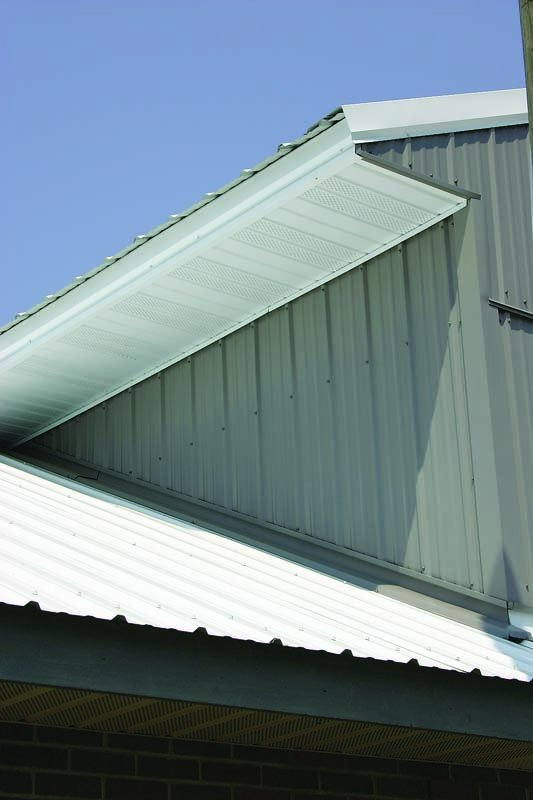
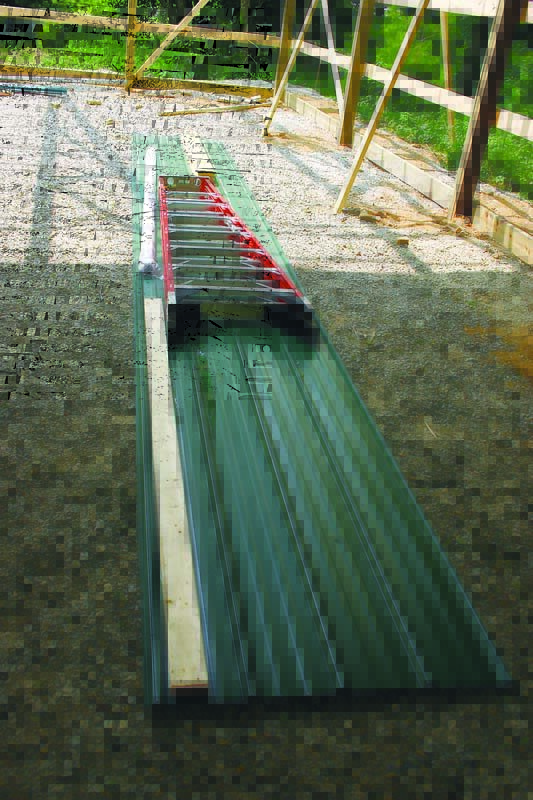
The combination of aluminum and zinc makes Galvalume a bit more finicky than galvanized, especially on a wet jobsite. It should be isolated from lead, copper, treated wood, unseasoned lumber, and wet cement. Isolation issues have been addressed, particularly with the influx of copper-based wood preservatives to the market — a barrier is recommended in applications where such wood meets steel sheet.
Galvalume’s finicky nature was addressed several years ago with the introduction to the market of Acrylume, or Galvalume Plus. Acrylume is an acrylic-coated product that resists fingerprinting and smudging during handling and installation at the jobsite, and provides resistance to storage stain and transit corrosion.
“Acrylume is the biggest recent innovation for Galvalume,” says Coleman. “It enhances the performance short-term, and the overall appearance.”
Warranties also pop up when comparing galvanized and Galvalume. Galvalume manufacturers issue warranties of 20 or 25 years, while galvanized sheets are typically not warranted. “The mills are willing to stand behind it,” Coleman says of Galvalume.
As with all warranties, the warranty should be examined closely. Galvalume warranties basically cover perforation or other structural failures, not red rust. They also come with exceptions, most notably animal confinement and marine applications.
Location, location, location
Most experts agree that animal confinement is the one clear rural building application where Galvalume should not be used.
“Years ago, galvanized was preferred in any ag confinement condition, and the industry followed that lead for the most part,” says Gary Crainshaw of Central States Manufacturing, which sells mostly Galvalume. “We’re seeing more people use Galvalume on poultry buildings these days. Recently I saw a bulletin that stated for poultry confinement applications, G-90 galvanized and AZ-55 Galvalume were anticipated to provide similar service lives. But for hog confinement and other more aggressive confinement conditions, heavily galvanized panels are recommended. Proper insulation, ventilation, and waste removal systems play a key role in extending the service life of metal panels.”
Location is not just an important consideration as it pertains to building type. Different parts of the country are more receptive to different coating combinations, according to Covell.
“I think it’s important for the installer or specifier that they recognize what kind of atmospheric condition the product will be installed in,” he says. “In all my testing and experience, heavy-coated galvanized with a zinc phosphate pretreatment is the most consistent product on the market.
“The two big things I look at are trying to prevent corrosion and chalk and fade, and how you do that depends on where you are in the country. If you have a plant in Texas, you could go with a G-60 substrate with a Kynar finish — there’s not as much corrosion, but the sun is brutal. But if you look at a PH map, you’ll see the most aggressive (corrosion) conditions are in the Atlantic Northeast, the Rust Belt, the Fertilizer Belt. It’s brutal. In the Southeast and further Midwest, Indiana, Missouri, Nebraska, you don’t have nearly the aggressiveness.”
Like Everlast’s, Wheeling’s product line reflects these atmospheric differences. Morelli says the majority of the company’s line is G-60 painted, and “we think that works very well,” he says. But some markets demand a G-90 or G-100 product, like the Northeast and parts of the Midwest, and Wheeling obliges. “I believe it starts with acid rain issues in the Northeast, they feel they need a little more protection,” Morelli says. “The market demanded it, and suppliers supply it.”
Know what you’ve got
But is the market always getting what it demands when it comes to galvanized products? G-40 products that make their way into the post-frame market have far less zinc to protect against corrosion than their G-60, G-90, or G-100 cousins. As Gieseke points out, there is a linear relationship between the amount of zinc on a panel and its long-term performance. “My guess is there is a lot of G-40 out there, people who are just buying ‘galvanized,’” he says. “You might think ‘Yeah, it’s just a farm building,’ but the farmer may have a nice house on that property, and he wants his barn to look nice, too. If he thinks he’s buying a long-term building, and he has a G-40 panel, he’s not finding out all the facts. The building’s going to fail quicker and he’s not going to be happy down the road.”
There is even more risk now that galvanizing lines have become more precise in their application processes. At one time, a G-60 panel may have been G-90 in actuality, or a G-90 as much as G-145 in spots. Now, tighter tolerances have brought zinc within 5-10 percent of their purported levels, leaving less corrosion-resisting “safety nets” throughout the surface area of a panel.
Cost-wise, galvanized and Galvalume products have been fairly comparable in recent years. The recent spike in zinc prices has changed that. One producer says Galvalume is currently cheaper than G-40 galvanized, and considerably less expensive than a more galvanized product.
In the end, can consumers tell the difference? Much like any other component that goes into a post-frame building, contractors need to educate themselves on the differences between galvanized and Galvalume panels before making a choice appropriate for their market and their customer.
“One of the big challenges we face is working through our distributors to educate the market,” says Crainshaw. “Many people are willing to pay the price for the right product, but they’re often not given the opportunity to make that choice. That concerns me about our market.”
Says Gieseke: “It’s a challenge. You put a G-40 panel next to a Galvalume panel and stand 10 feet away, when they’re brand new you can’t tell the difference. It’s not like the difference between a Montblanc pen and a Bic. When you’re looking at brand-new buildings a week old, you can’t see the difference, but down the road, you will.”
Resources
•U.S. Steel technical bulletins www.ussteel.com/metal/bltn.shtml
•Galvalume Sheet Producers of North America www.steelroofing.com