
Originally Published as: Garage Door Trends: What Builders Need to Know
The overhead door is now a major cost and design consideration for post-frame, metal, and residential-accessory projects. Overhead doors are being considered earlier in the design process to help builders avoid costly changes, challenges and scheduling delays. With rising material costs, steel tariffs, and customers arriving with specific color and R-value preferences, the following outlines the market outlook for 2027.
A Market Growing Despite a Soft Housing Backdrop
U.S. garage door manufacturing has faced challenges over the past five years. According to IBISWorld, higher interest rates and slower housing starts have kept revenue nearly flat, declining at about 0.8% annually, with a modest rebound to $6.5 billion expected in 2026. Manufacturers have responded by focusing on repair and replacement, where most design-trend spending now occurs. Globally, the market is stronger: research estimates the worldwide garage and overhead door market at $19–24 billion, with commercial overhead doors projected to grow from $3.6 billion in 2026 to $4.9 billion by 2030, driven by warehouse, logistics, and automation demand.

Steel Costs and Tariffs Are Back in the Conversation
Most garage doors continue to use steel skins, and tariff policy remains a key factor in production and pricing. Trade researchers note that recent U.S. tariffs and trade tensions have increased domestic steel and aluminum prices while reducing import competition. This benefits domestic mills but creates cost pressures for manufacturers and builders quoting projects in advance. The Door and Access Systems Manufacturers Association (DASMA) has monitored these trends through previous tariff cycles and remains an important resource as manufacturers typically pass steel cost increases to dealers and installers.
Matte Black, Charcoal, and Faux Wood Lead the Style Trends
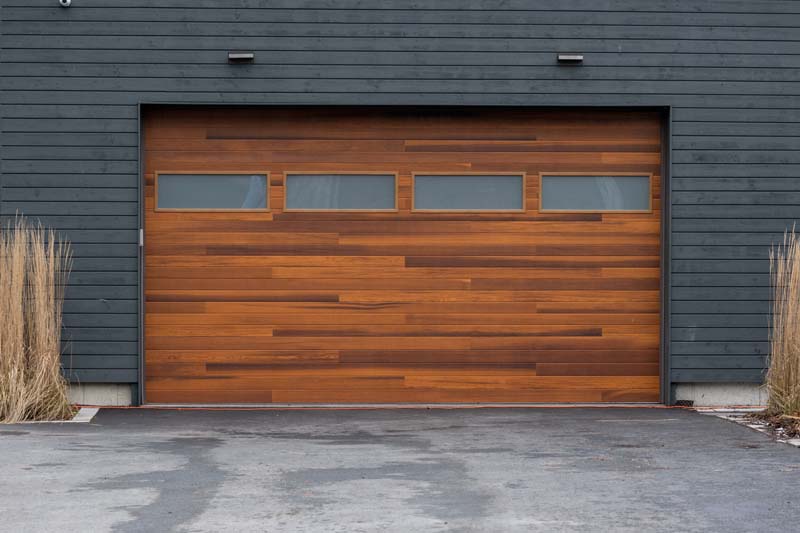
Matte black, dark charcoal, and faux-wood finishes are currently the most requested styles for modern homes. Dealer-focused trend reports consistently highlight the following style categories:
• Full-view glass and aluminum — slim aluminum frames paired with large clear or frosted glass panels for a bright, contemporary look.
• Flush-panel and linear steel — smooth, minimalist flat panels suited to mid-century and modern properties.
• Modern carriage house — the traditional barn-style silhouette updated with black or minimal hardware for a hybrid classic look.
• Vertical slats — vertical lines that add geometry and height to contemporary architecture.
Regarding color and finish, the same sources identify a consistent group of leading options:
• Matte black and charcoal — high-contrast dark tones replacing the traditional plain-white door.
• Warm wood-grains — deep walnut, espresso, and composite faux-wood overlays that provide organic warmth without the maintenance of real wood.
• Iron ore and warm grays — softer than pure black, and versatile enough to pair with blond woods, warm whites, and brick.
On the functional side, three upgrades are consistently highlighted in dealer and manufacturer trend reports:
• Slim windows — narrow, horizontal windows placed high or stacked vertically, favored over large traditional window grids.
• High insulation (R-value) — thicker, multi-layer insulation as more homeowners convert garages into gyms, offices, or workshops.
• Smart integration — built-in Wi-Fi connectivity and smartphone apps for remote monitoring and voice control.
For builders, the key consideration remains consistent across styles: dark colors, faux-wood finishes, and glass usually involve higher costs and longer lead times than standard steel doors. It is important to communicate these factors during the estimating stage rather than after an order is placed.
Insulation Is No Longer an Upsell
Polyurethane-injected panels are replacing polystyrene cores, offering both structural rigidity and improved R-value. This combination is increasingly important as post-frame buildings are used as workshops, gyms, or living spaces. Builders should anticipate that customers in 2026 and 2027 will request specific R-values and expect clear information on whether a door’s foam is laid in or injected under pressure.
Smart Openers Are the Default, Not the Upsell
Wi-Fi-connected openers with smartphone control, remote diagnostics, and battery backup are now standard for residential and light-commercial projects. In commercial settings, these features enable automated scheduling and traffic monitoring to reduce energy loss from doors remaining open unnecessarily. Builders can highlight these benefits when customers consider basic and connected openers.
The Takeaway for Builders
As 2027 approaches, customer expectations for features such as insulation, finish options, and smart openers are increasing, while material costs remain volatile due to tariffs and steel pricing. Builders who address both customer demands and cost fluctuations, and who allow for schedule flexibility in their quotes, will be better positioned to avoid challenges on long-term projects.
Sources & Resources
• American Garage Door Factory — americangaragedoorfactory.com. Manufacturer of premium and custom garage doors, including its Lexington custom door series and related hardware lines.
• Kevmar Manufacturing — kevmar.net. Garage door hardware and component supplier; carried as a brand line by regional overhead door dealers.
• Integrity Overhead Door — integrityoverhead.com. Overhead door dealer and installer based in Lagrange, Indiana, serving Northeast Indiana and Southwest Michigan.
• C.H.I. Overhead Doors — chiohd.com. Arthur, Illinois-based manufacturer of residential and commercial sectional and rolling steel doors.
• Overhead Door Corporation (Overhead Door and Wayne Dalton brands) — overheaddoor.com. Lewisville, Texas-based manufacturer of residential, commercial, and industrial doors and openers.
Market Data & Design-Trend Sources
“Garage Door Manufacturing in the US” — IBISWorld, June 2026. Industry revenue trends, tariff and material-cost pressure, and the shift toward repair/renovation demand.
“Garage and Overhead Doors Global Market Report” — The Business Research Company. Global market sizing, plus specific analysis of tariff and trade-policy impact on steel, aluminum, and door components.
“Commercial Overhead Doors Global Market Report 2026” — GII Research. Commercial-segment sizing and growth drivers through 2030.
Door and Access Systems Manufacturers Association (DASMA) — dasma.com. The door and access systems industry’s trade association; publishes Door & Access Systems magazine and tracks tariff and steel-cost impacts on manufacturers.
“Modern Garage Door: 8 Design Trends & Top Styles 2026” — Apple Door and Cheney Door Co. Style, material, and pricing roundups behind the full-view glass, flush-panel, and vertical-slat trend data above.
“Top 5 Garage Door Trends You Can’t Miss” — Newman Windows and Doors, Stay Glassy Ep. 5. Dealer-perspective video and transcript covering insulation R-values, smart openers, and finish trends.
“New Garage Door Styles” — Garaga and Action Overhead Garage Door. Manufacturer and dealer trend pages covering iron ore and warm-gray color trends, wood-tone finishes, and slim window styles.
“Top Garage Door Trends for 2026: What Homeowners Are Choosing Now” — Sears Garage Doors. Consumer-side color, material, and glass-panel trend coverage.