
Originally Published as: Do R-Values Really Matter? What Frame Builders Need to Know
Editor’s Note: This article draws on original reporting first published in the February 2025 issue of Rural Builder magazine, adapted here for Frame Building News readers.
Ask a post-frame or metal-frame builder whether R-values matter, and the honest answer is yes—but not in isolation. High energy costs and increasingly strict building codes have made insulation performance a routine part of the bid conversation. Understanding what an R-value actually measures, and where it falls short, helps builders answer client questions accurately and stay on the right side of code officials.
R-Value vs. U-Factor: Two Different Measurements
R-values measure an individual insulation product’s resistance to heat flow. U-factors measure something broader: overall heat transfer through an entire building assembly—a wall, roof, or floor system—including framing, windows, doors, and other components that aren’t insulation at all. David Tomchak, Director of Marketing & Technical Services for Bay Insulation Systems, put it this way: “R-value relates to specific insulation products while U-factor relates to insulation assemblies.”
R-values are the number most builders and customers recognize, partly because higher is intuitively better. That wasn’t always the industry standard. According to GreenBuildingAdvisor’s article “Understanding R-Value,” the insulation industry relied on U-factors until Everett Shuman, director of Penn State’s Building Research Institute, proposed the R-value — the mathematical inverse of U-factor — because a rising number was easier to market than a falling one.
Why This Matters More in Frame Construction
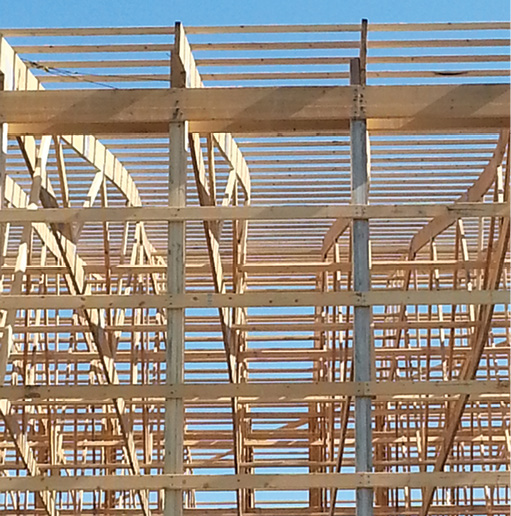
Post-frame and metal-frame buildings have a structural advantage that shows up as a thermal disadvantage: repeating framing members. Every wood post, girt, or steel stud that interrupts a run of insulation creates a thermal bridge — a path of lower-resistance material that conducts heat between interior and exterior faster than the insulation around it. Air infiltration through gaps at penetrations, service openings, and door and window rough openings does the same thing, but through a different mechanism. Because R-value only rates the insulation product itself, a wall system can be built with high-R material and still underperform if you don’t address thermal bridging and air sealing. That’s the gap U-factor calculations are meant to close, and it’s why an insulation package that looks good on a spec sheet doesn’t always translate into the assembly performance a building actually needs.
Climate Zones, Codes, and Which Standard Applies
The International Residential Code (IRC) and International Energy Conservation Code (IECC) both reference the same map, which divides the U.S. into eight climate zones. Each zone carries its own minimum R-value requirements: colder zones require more insulation, and warmer zones require less. ASHRAE — the American Society of Heating, Refrigerating, and Air-Conditioning Engineers — publishes a separate energy standard, ASHRAE 90.1, that some state and local jurisdictions adopt instead of, or alongside, the IECC.
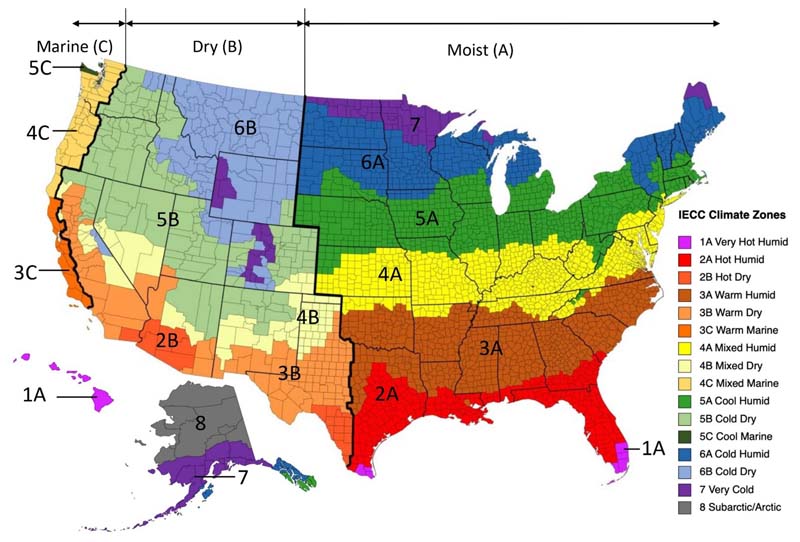
“Typically, to determine what insulation is required, the factors you need to consider are climate zone and what the local and/or state municipalities have adopted as code, including the year,” Tomchak said. “Both ASHRAE 90.1 and the IECC publish a new standard every three years. However, they don’t do it concurrently or communicate directly with each other. They are two different bodies. Therefore, it is important to understand what may have changed from IECC 2012 to IECC 2015 to IECC 2018 to IECC 2021 to IECC 2024; or from ASHRAE 90.1-2013 to ASHRAE 90.1-2016 to ASHRAE 90.1-2019 to ASHRAE 90.1-2022, etc.”

Required R-values also vary by which part of the building envelope you’re insulating. A floor assembly in Climate Zone 1 might need only R-13, while the same floor in Zone 7 or 8 might need R-38.
Mass vs. Reflective Insulation
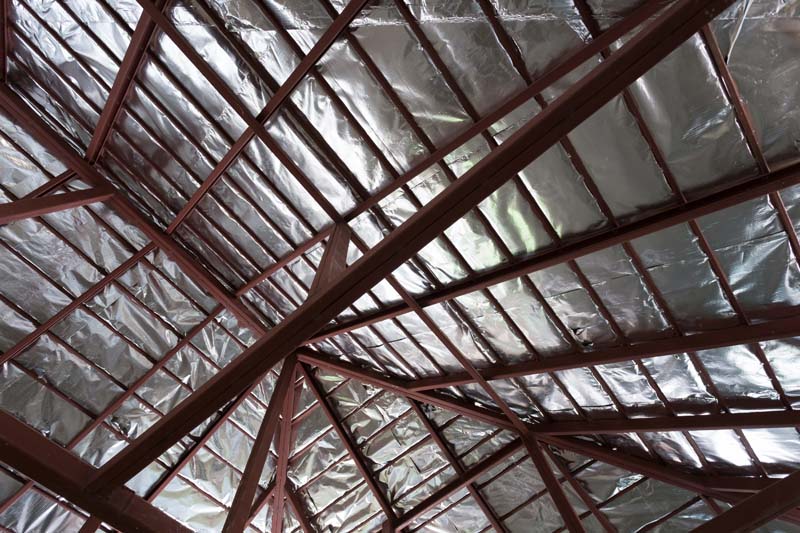
Insulation generally falls into two categories: mass and reflective. Mass insulation, such as fiberglass batting, reduces heat transfer mainly through conduction and convection. Reflective insulation works differently. David Yarbrough of R&D Services, Inc., a consultant to the Reflective Insulation Manufacturers Association International (RIMA-I), explained that reflective products “have thermal resistance (R-values) like all insulation products used in buildings.” Still, their performance depends on “a significant reduction in heat transfer by thermal radiation” rather than conduction — achieved through low-emittance, high-reflectance surfaces installed to form enclosed reflective air spaces.
Installation method matters as much as material choice. Spray foam is applied as a liquid and must reach a consistent thickness to meet its rated R-value. Fiberglass batts are manufactured to a consistent thickness but are soft enough to compress, which lowers effective R-value on the job site. Both are vulnerable to gaps that can pull an installed assembly below code minimums even when the product itself is correctly specified.
Documentation Builders Should Keep
Reputable insulation suppliers carry third-party certification of R-value, such as Home Innovation Research Labs’ certification mark for fiberglass products. The IECC also spells out what to document on the job site. Under Section C303.1.1, insulation must carry a manufacturer’s R-value identification mark, or the installer must certify the type, manufacturer, and R-value installed in each building element. For blown-in or sprayed fiberglass and cellulose, that certification must list initial and settled thickness, settled R-value, installed density, coverage area, and bags installed. For spray polyurethane foam, it must list installed thickness and R-value. The installer signs, dates, and posts the certification on site.
The Bottom Line
R-values matter — they’re the baseline number that codes, suppliers, and customers all reference. But an R-value only describes a single material, not the wall, roof, or floor assembly it ends up in. For frame builders, thermal bridging through repeating structural members and air leakage at penetrations are the details that decide whether an insulation package performs the way its rating suggests. Tomchak put the larger point plainly: “Just because new energy codes are established, it doesn’t automatically mean that they must be followed. It is the local and state jurisdictions that decide what to adopt, whether it is a code or standard, and the applicable date of that code or standard.” Builders who track both the number and the assembly it lives in stay compliant, competitive, and able to answer for the building’s performance after the crew has left the site.
Resources
David Tomchak, Director of Marketing, Bay Insulation Systems — https://www.bayinsulation.com
David Yarbrough, R&D Services, Inc., consultant to the Reflective Insulation Manufacturers Association International (RIMA-I) — https://rdservices.com
Reflective Insulation Manufacturers Association International (RIMA-I) — https://rimainternational.org
International Code Council — International Energy Conservation Code (IECC) — https://www.iccsafe.org
ASHRAE (American Society of Heating, Refrigerating and Air-Conditioning Engineers) — https://www.ashrae.org
U.S. EPA ENERGY STAR — recommended insulation levels — https://www.energystar.gov
Home Innovation Research Labs — insulation certification — https://www.homeinnovation.com
GreenBuildingAdvisor.com, “Understanding R-Value” — https://www.greenbuildingadvisor.com/article/understanding-r-value
R-foil —https://rfoil.com/
Central States Manufacturing — https://centralstatesco.com
Everlast Roofing, Inc. — https://everlastroofing.com
Direct Metals, Inc. — https://directmetalsinc.com
EPDM Coatings — https://www.epdmcoatings.com
Levi’s Building Components (PoleSaver PF) — https://www.levisbuildingcomponents.com/polesaver-pf
Stockade Buildings, Inc. — https://www.stockadebuildingsinc.com
Marion Manufacturing — https://marionmanufacturing.com
Creekside Manufacturing — https://creeksidemanufacturing.com
Cold Spring Metal — https://www.coldspringmetal.com
Construction Rollforming Show — https://rollformingmagazine.com/construction-rollforming-show-registration/
Bay Insulation Systems — https://www.bayinsulation.com
R&D Services, Inc. — https://rdservices.com
RIMA International — https://rimainternational.org
International Code Council (ICC) — https://www.iccsafe.org
ASHRAE — https://www.ashrae.org
ENERGY STAR (U.S. EPA) — https://www.energystar.gov
Home Innovation Research Labs — https://www.homeinnovation.com