
Originally Published as: Designing Insulation for Steel-Clad Post-Frame Buildings
Mike Momb has been Technical Director for Hansen Pole Buildings, LLC of Browns Valley, Minnesota for more than 20 years. His daily post-frame blog, as well as his weekly “Ask the Pole Barn Guru” column can be followed at the company website, www.hansenpolebuildings.com/blog/.
As a pole barn (post frame) building neophyte four decades ago, almost all buildings were designed for cold storage, rarely was insulation or potential climate control even a topic for discussion. In today’s post frame world, most buildings will need or must have some degree of climate control.
Potential post frame building owners often overlook proper insulation planning for several reasons. Post frame building providers and builders (lumped together as providers for sake of brevity to follow) more-often-than-not play into this.
Focus on Structural Aspects: Providers often prioritize building’s structural integrity and aesthetics over energy efficiency. Insulation, while crucial, may be seen as a secondary concern.
Lack of Awareness: Many owners may not fully understand insulation’s importance in maintaining energy efficiency and comfort. Insulation is often seen as an afterthought rather than a critical building process component. Some providers may not be fully aware of latest insulation technologies and their benefits, leading to insufficient recommendations for energy-efficient solutions.
Cost Considerations: Insulation can add to initial construction costs. Some owners may prioritize immediate savings over long-term benefits, leading them to skimp on insulation. Providers are often selling on low price, rather than best design solutions for their clients. Discussing insulation can lead to higher initial costs, causing some to avoid to keep projects within a perceived budget. They may fear emphasizing insulation needs could deter clients. Keep in mind, there is always someone willing to cut quality and/or service for a lower price.
Complexity of Installation: Insulating a post frame building can be perceived as a complicated task. Owners might feel overwhelmed by technical aspects, such as selecting right insulation types and ensuring proper installation techniques.
Focus on Aesthetics: Designing a new building is exciting, owners may prioritize visual appeal and layout over functional elements like insulation. After all, it is not visible once the building is completed.
Client Knowledge Gap: Many clients may not understand insulation’s importance, so providers might assume it’s not a priority for them. This can result in a lack of proactive communication about insulation options.
Misunderstanding Building Codes: Some may not be fully aware of local building codes dictating insulation requirements, leading to inadequate planning. Plus, building codes regarding insulation can vary significantly by location. Providers might not emphasize insulation if local codes do not mandate specific R-values or insulation types.
Procrastination: There can be a tendency to delay insulation planning, thinking it can be addressed later. This procrastination can lead to higher energy bills and long run discomfort.
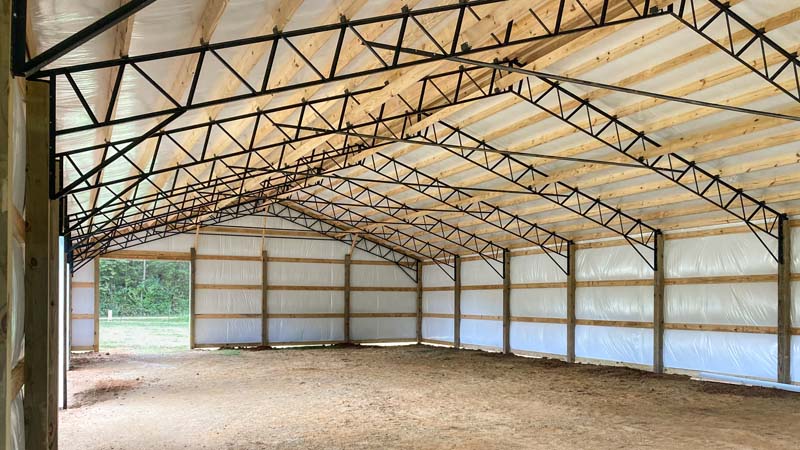
Unlike stick frame construction, post frame buildings can be very efficient in reducing thermal bridging. By utilizing 2×8 bookshelf wall girts 24 inches on center on a 3 ply Glulaminated column, less than 6% of a given wall has a wood member touching both exterior and interior surfaces, under half of typical stick frame!
Importance of Insulation
Proper insulation in a post-frame building serves several purposes:
- Energy Efficiency: Insulation minimizes heat loss in winter and heat gain in summer, reducing reliance on heating and cooling systems.
- Moisture Control: Effective insulation helps prevent condensation. If overlooked condensation can lead to mold, rust, and structural damage. Insulation helps maintain a consistent indoor temperature, preventing warm, moist air from coming into contact with cold surfaces where condensation typically forms. This is particularly important in winter when temperature difference is significant.
- Comfort: A well-insulated building maintains a stable indoor temperature, enhancing comfort for occupants.
- Noise Reduction: Insulation can also dampen sound, making interiors quieter.
Types of Insulation
When selecting insulation for a steel-covered post-frame building, consider the following options:
- Fiberglass Batts: A common choice due to its cost-effectiveness and ease of installation. It is available in various R-values, measuring thermal resistance. Generally, fiberglass insulation is fairly affordable, making it a popular choice for budget-conscious projects.
- Mineral Wool Batts: Offer a higher R-value than fiberglass, typically around R-30 for a 7.25-inch thickness, meaning better thermal resistance (roughly 50% greater than fiberglass). Naturally repels water and resists mold growth. Has a slight edge in sound absorption over fiberglass due to its density.
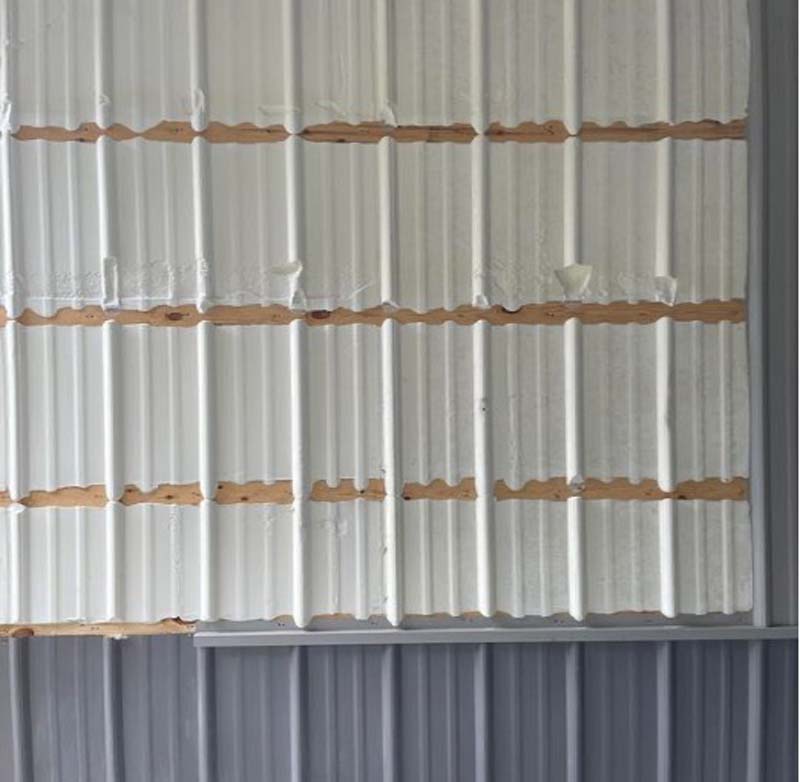
- Closed Cell Spray Foam Insulation: Offers superior air sealing and higher R-values per inch compared to fiberglass or mineral wool. It expands to fill gaps, providing excellent moisture control.
- Blown-In Insulation: Ideal for attics and hard-to-reach areas, blown-in fiberglass, granulated mineral wool or cellulose can create a thick thermal blanket. If moisture is introduced to cellulose, it can create an environment conducive to corrosion of steel panels. This is due to certain hygroscopic fire retardants exacerbating this issue by retaining moisture against steel.
- Rigid Foam Board: Provides a high R-value and can be used on walls and ceilings. It is particularly effective as a continuous insulation layer, however should not be placed over framing and directly under steel cladding as shear strength of steel will be greatly reduced or entirely negated.
Determining R-Value Requirements
R-value needed for insulation depends on climate zone and intended building use. Building Codes provide guidelines for recommended R-values based on geographic location. For Residential structures, see IRC Chapter 11. For other structures refer to International Energy Conservation Code requirements.
So What to Do?
These are broad recommendations based upon my experience.
In Climate Zones 0 through 2:
Closed cell spray foam applied directly to interior face of steel roofing and siding. This will necessitate having to mechanically dehumidify interior spaces.
From Dr. Richard “Rick” Duncan, P.E. Technical Director for the Spray Polyurethane Foam Alliance (SPFA), “Closed-cell naturally shrinks as it cools and cures. It can take about a month for the gases in the cells to come to pressure equilibrium with the atmosphere. When applying SPF to large open areas of metal panels, the shrinkage of the foam can cause some panels to pull inward. We call this oil canning.
Oil canning occurs most frequently on large unsupported panels (about 4’x4’ and larger areas) and on thin gage panels with small ribs. For these large, thin panel areas, use picture framing and apply a thin flash coat to minimize oil canning…especially on ground-level walls where oil canning can be easily seen.
One of the concerns that the metal building industry had was exothermic temperature damage to coatings and primers used on metal panels. A few of the metal panel manufacturers were voiding their warranties because of this concern. Our study measured exothermic temperatures of the panel during spraying and the temperatures were below 150°F, which should not affect these coatings.
Our study also looked at using different fabrics applied during construction between the sheet metal panels and the framing. We included Tyvek WRB and non-woven ‘BIBS’ fabric. We found that SPF does not adhere well to the more expensive Tyvek. It does adhere to the lower-cost non-woven. We did see that the foam would pull the non-woven fabric away from the panel by about ½” and eliminates oil-canning. The difficulty with using non-woven fabric is that it must be applied during construction.”
From MCA (Metal Construction Association)’s technical bulletin “Spray Polyurethane Foam Insulation on Interior Surfaces of Metal Panels”:
“Closed-cell foam is recommended due to its water resistant capabilities. Some SPF contractors use a release material such as building wrap or fabric to allow for easier change out of damaged panels, however the use of a release material poses the potential of creating air gaps between the back of the SPF foam and the metal panel. These gaps could allow condensation to accumulate between the SPF and the panel and framing members.”
In other climate zones:
Minimum R-5 (R-10 being both recommended and preferred) insulation shall be provided under full slab area of a heated slab in addition to required slab edge insulation R-value for slabs as indicated in 2021 International Energy Conservation Code (IECC) Table R402.1.2 Footnote (d). Slab edge R-10 insulation is required in Climate zones 3 and greater, with depths of 24” for zone 3, 48” for zones 4 and greater.
Next two paragraphs are paraphrased from Building Science Corporation’s Joe Lstiburek in BSI-059:
Do you really need to insulate vertically if you insulate slab edge and insulate under slab at perimeter? Yes and no. Yes in climate zones 4 and higher, no in climate zones 3 and lower. Is this based on a hygrothermal analysis? No. Is this based on an energy payback analysis? No. Is this based on minimizing your carbon “footprint”? No. Get serious. It is based on something real. We found in climate zones 4 and higher if you didn’t do it people felt uncomfortable. It is not a good idea to annoy your clients. Especially if they are old – remember you will get old too – sooner than you expect.
How far inboard should you insulate horizontally? We pick four feet. Yup, this typical rigid insulation sheet width and we go with it. Everywhere? Pretty much. Is there ever any reason to insulate entire slab besides perimeter? Yes, Grasshopper, whenever you have in-slab heating or whenever you have hot-humid summers like you have in Maine, Massachusetts, and Michigan. Those “M” states are a pain. Ground under a slab is still often cold in summer when it finally gets nice outside in “M” states and slab top can fall below outside air-vapor mixture dew temperature when folks are finally brave enough to open windows and doors.
Walls (from out to in): Steel siding, Omnidirectional Housewrap meeting ASTM E2273 drainage efficiency requirements, 2×8 Bookshelf wall girts blocked solid to 3-ply Glulaminated columns, R-30 mineral wool batts, vapor barrier on warm side of insulation to prevent moisture from entering building (this is crucial in climates with significant temperature differences between indoor and outdoor environments), interior finish.
Roof/ceiling (from out to in): Roof steel with factory applied Integral Condensation Control, Vented Eaves and Ridge, raised heel trusses (at least an inch taller than thickness of insulation blown in over finished ceiling).
According to Joe Lstiburek, “Plastic vapor barriers should only be installed in vented attics in climates with more than 8,000 heating degree days.”
Don’t Ignore Air Leaks: Seal any gaps or cracks in building envelope to enhance insulation effectiveness.
Insulating a steel-covered post-frame building is a vital investment paying off in energy savings, comfort, and longevity. By carefully selecting insulation materials, ensuring proper installation, and maintaining moisture control, a comfortable and efficient space can be created to meet user needs for years to come.